
The Strait of Hormuz crisis has underscored a pressing question for contemporary international law: how effective are legal safeguards when strategic waterways become instruments of geopolitical coercion?
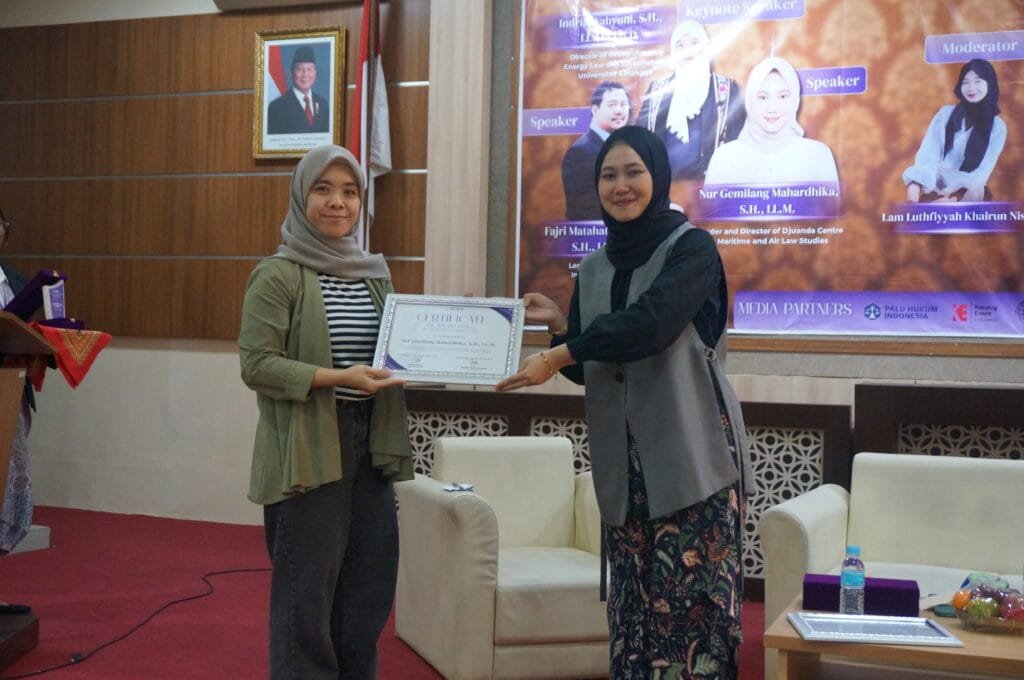
This question formed the centrepiece of “Fragile Passages: The 2026 Strait of Hormuz Crisis and the Limit of International Law in Safeguarding Maritime Energy Transit,” a presentation delivered by Nur Gemilang Mahardhika, Director of Djuanda Centre for Maritime and Air Law Studies, at the Surakarta International Legal Summit 2026 in June.
The presentation examined the tensions between the established legal framework governing international navigation and the geopolitical realities that shape its implementation. Although the United Nations Convention on the Law of the Sea (UNCLOS) provides a legal framework for transit passage through international straits, the existence of these rules does not, in itself, guarantee their effective observance. Their practical force remains closely tied to state compliance, strategic interests, and the wider balance of geopolitical power.
The Strait of Hormuz illustrates this fundamental paradox. A waterway of immense significance to international commerce and energy transit can become a site of geopolitical coercion, exposing the limitations of legal rules when the continuity of navigation is challenged by strategic confrontation. The resulting consequences extend beyond the immediate parties to a crisis, affecting maritime states, energy-dependent economies, and the stability of global supply chains.
Beyond Sovereignty: Rethinking Maritime Connectivity
A central argument of the presentation was that contemporary maritime law must be understood not only through the traditional lens of sovereignty and navigational rights, but also through its capacity to safeguard the continuity of global maritime connectivity.
As strategic waterways become increasingly entangled with energy security, critical infrastructure, and international economic interdependence, disruptions to maritime transit can generate consequences far beyond the waters in which they originate. The weaponisation of energy resources and the strategic vulnerability of essential transit routes demonstrate how maritime connectivity has become inseparable from broader questions of economic resilience and international security.
This development invites a wider consideration of what maritime law must protect. Beyond defining the rights and obligations of states, the legal framework must also be examined in light of the conditions necessary for international navigation and the movement of essential resources to remain resilient amid geopolitical disruption.
The presentation therefore highlighted the importance of examining international maritime law alongside the economic and security dimensions of global connectivity. It raised a broader question for legal scholarship and policy: how can existing legal frameworks be interpreted, implemented, and strengthened to address the vulnerabilities of an increasingly interconnected maritime order?
Why the Strait of Hormuz Matters to Indonesia
For Indonesia, these questions carry particular significance. As the world’s largest archipelagic state, Indonesia depends on maritime connectivity for trade, economic activity, and its engagement with regional and global markets. Its strategic position across major sea lanes also places it within a maritime environment where the security and continuity of navigation have consequences extending beyond national jurisdiction.
The Strait of Hormuz crisis consequently offers more than a distant geopolitical case study. It provides an opportunity to consider the resilience of maritime transit arrangements and the relationship between international legal obligations, strategic competition, and the protection of economic connectivity. The challenges confronting one strategic waterway may illuminate broader vulnerabilities relevant to other maritime regions, including those vital to Indonesia.
In this context, resilience should not be treated merely as a policy aspiration. It warrants sustained legal and institutional attention, particularly as states confront the growing interdependence of maritime routes, energy resources, infrastructure, and global mobility.
Advancing Maritime and Air Law Scholarship
Djuanda Centre’s participation in the Surakarta International Legal Summit 2026 reflects its commitment to engaging with contemporary challenges at the intersection of international law, maritime affairs, and public policy. Through research, publications, and academic dialogue, the Centre seeks to examine how legal frameworks operate not only in formal texts, but also amid the geopolitical, economic, and environmental realities that shape their application.
The Strait of Hormuz crisis demonstrates why such engagement matters. Legal principles remain essential to an orderly international maritime system, yet their effectiveness must also be considered against the practical conditions under which states exercise power and international connectivity is maintained.
For Djuanda Centre, the task is therefore not simply to revisit established legal rules, but to foster critical conversations about their capacity to respond to an evolving maritime order. By connecting legal scholarship with contemporary strategic challenges, the Centre aims to contribute to a deeper understanding of the relationship between maritime authority, international navigation, and the resilience of global connectivity.
Fragile passages demand resilient legal thinking. As the strategic significance of maritime routes continues to grow, the challenge for international law is not only to establish the rules governing navigation, but also to confront the conditions that determine whether those rules can meaningfully safeguard the connections upon which states and societies depend.
At Djuanda Centre, this commitment continues through every dialogue, every publication, and every horizon explored.